
Projected and Actual Dates Differ
TDCJ defines its Projected Release Date as a date calculated by Classification and Records for release from incarceration if parole does not occur sooner. It can change as legal and administrative facts change. The Maximum Sentence Date is a companion field, especially important when discretionary mandatory supervision is denied and TDCJ recalculates the projection toward maximum expiration.
An actual release record documents the completed custody transaction: date and time, reason or authority, and possibly destination. “Parole eligible,” a favorable vote, or a scheduled date does not establish physical release. Conditions, program completion, residence approval, detainers, and processing can remain. A person can also leave one facility while remaining in custody through transfer.
Sentence completion and release from a particular building are also separate questions. A person physically leaving Robertson on parole remains under TDCJ authority. Someone transported from Middleton to another unit never left state custody. A person delivered from the county jail to Bluebonnet entered an immigration-custody path. For each event, record both the sending agency’s disposition and the receiving agency or supervising office. That paired evidence prevents an accurate departure date from being misreported as a full discharge date.
Find a TDCJ Projected Release Date
- Confirm the person is or was in TDCJ rather than only the Jones County Jail, ICE, or federal custody.
- Open the official TDCJ Offender Search. Search with the TDCJ number or SID when possible; otherwise use name and matching identifiers.
- Read current facility, projected release, maximum sentence, and parole-review fields together. Do not isolate one date from its status.
- Compare the offense title and date with the governing sentencing rules. Similar sentences can calculate differently.
- For a time-sensitive or historical question, contact TDCJ Classification and Records at 936-437-6231 or classify@tdcj.texas.gov. The public search warns that it updates on working days and is at least 24 hours old.
- Confirm completion through a release/discharge record, Board status, or the supervising office. The Parole / Probation guide explains the post-release distinction.
The TDCJ inmate-information email can provide limited status details, but formal records requests use PIA@tdcj.texas.gov, TDCJ’s online request form, or mail to TDCJ Public Information Request, P.O. Box 4017, Huntsville, TX 77342. A focused request can seek admission, unit movements, release or discharge date and type, maximum expiration, and the supporting record.
The official search page shows the fields used for this process. Open the TDCJ offender search source before reviewing the captured example below.
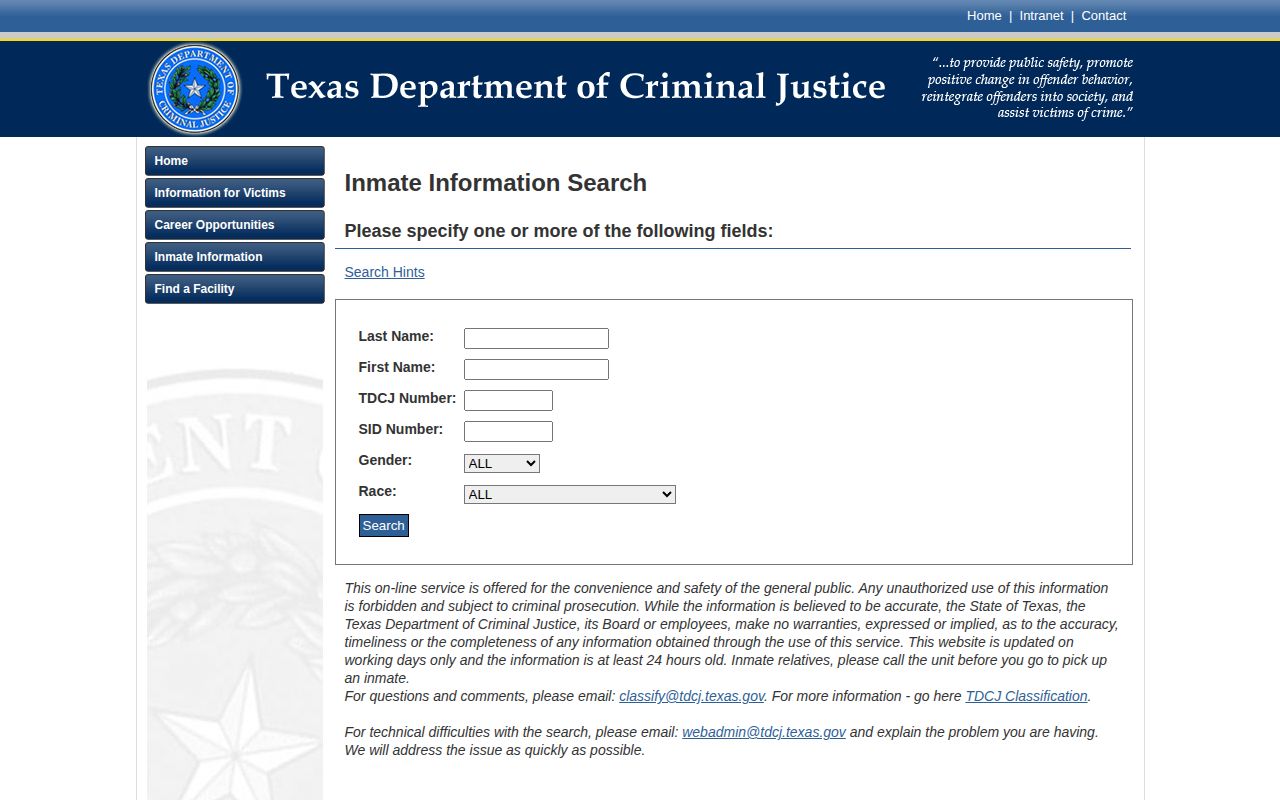
The screen is a statewide status tool, so its facility and calculation fields must be interpreted together and then confirmed when the release date is near.
County Jail Dates Use Different Records
The Jones County Jail is operated by the Sheriff’s Office. Its official page provides P.O. Box 821, Anson, TX 79501, telephone 325-823-3201, and fax 325-823-2099, but no current roster, release-date calculator, jail good-time policy, or published weekend-release practice. Do not apply TDCJ formulas to this local custody episode.
For one person, ask the Sheriff for booking number, booking and release date and time, charges and cause numbers, bond type and posting time, release reason and authority, and public transfer destination. Then obtain the judgment, sentence, jail-credit entry, bond or release order, modification, dismissal, or discharge order from the correct clerk. County misdemeanor matters generally go to the County Clerk; district felony cases go to the District Clerk.
A court order demonstrates legal authority but may not show when release processing finished. Conversely, disappearance from a custody view does not reveal whether the person posted bond, completed time, transferred to TDCJ, entered ICE custody at Bluebonnet, or moved elsewhere. Match cause number and booking number and request the actual checkout time.
Texas Good Time Is Not Sentence Reduction
Government Code §498.003 governs good-conduct classification and award rules, §498.004 permits forfeiture for misconduct, and §498.005 limits the credits’ effect. Applicable credits affect parole or mandatory-supervision eligibility; they do not shorten the judicial sentence itself. Mandatory supervision is governed by §§508.147 through 508.149, including excluded cases and discretionary denial. Parole eligibility under §508.145 varies by offense, offense date, sentence, and statutory category.
For eligible offenses before September 1, 1996, TDCJ describes mandatory-supervision release when calendar time plus applicable good time reaches the term if parole has not occurred. For eligible later offenses, BPP must approve discretionary mandatory supervision. A denial may cause TDCJ to recalculate toward maximum expiration; a later approval may move the date earlier to allow processing. Legally excluded cases generally reach maximum expiration unless parole occurs first.
Texas has no universal 85-percent rule. Certain serious-offense provisions use calendar-time formulas such as one-half of the sentence or 30 years, subject to statutory minimums, limits, and special categories. Life sentences, capital cases, repeat sexual offenses, and consecutive sentences have distinct provisions. Eligibility opens review; it does not guarantee release.
Why the Displayed Date Changes
| Factor | Possible effect | Record to check |
|---|---|---|
| Good-conduct credits or forfeiture | Changes eligible calculations where law permits | TDCJ time calculation and disciplinary record |
| BPP grant or denial | May move release earlier or toward maximum expiration | Parole Review Information and vote code |
| Program or release-plan condition | Approval may precede physical release | BPP notice and Review and Release Processing |
| Detainer or hold | May lead to another custodian instead of the community | Release transaction and receiving-agency record |
| Court order or sentence change | Can alter controlling legal dates | Judgment, docket, amended order |
| Working-day data lag | Public page may trail current status by 24 hours or more | Classification and Records confirmation |
No single field answers every release question. Around weekends and holidays, call the responsible TDCJ route for urgent verification. Still distinguish a favorable decision, a scheduled processing date, departure from a unit, arrival at another custodian, and return to the community.
Middleton Movement and Robertson Release
Jones County’s co-located TDCJ units illustrate why location is not outcome. John Middleton Unit is a transient facility and houses the Western Region Offender Transportation Office. Leaving Middleton often means movement to French Robertson Unit or another TDCJ facility, not discharge.
French Robertson Unit is identified by TDCJ as a Regional Release Site and publishes CHANGES/Pre-Release and Reentry Planning functions. It is a genuine physical release node, but presence there does not prove imminent release and not every prisoner there discharges from that site. The statewide TDCJ status, actual release transaction, BPP decision, and supervision assignment distinguish transport from release.
If a person leaves Jones County Jail for TDCJ, wait for intake lag and search statewide. If a person leaves for Bluebonnet Detention Facility, use ICE’s locator and immigration records. Neither transfer is a community release even though county custody ended.
Confirm the Completed Release
Texas IVSS-Counties covers local jail events and allows a Jones County registration, while the separate statewide TDCJ IVSS covers people in TDCJ custody or on parole or mandatory supervision. Use the VINELink Release Check instructions to reach the correct current portal. A notification can identify a reported event, but no-result status is not proof and an alert should be reconciled with the custodian.
For state release, record the displayed dates, BPP status, actual transaction, and assigned parole office. For county release, record the Sheriff’s date, time, reason, authority, and transfer destination, then compare the court case. For ICE or federal custody, use the appropriate federal locator and disposition record. The word “released” can describe release from one agency while another agency immediately takes custody.
Build a dated timeline when the public fields conflict. Note sentence start, offense date, current unit, parole review, projected release, maximum sentence, and the day the page was checked. Ask which event each date represents. Projected release from incarceration may begin parole or mandatory supervision rather than complete the sentence. Maximum expiration may control if no earlier release occurs, while a Board approval only records a decision. Conditions, placement, detainers, or processing may still remain.
Research found no official Jones County rule promising a release hour, weekday, holiday adjustment, pickup point, property process, or transportation arrangement. Robertson’s regional release-site designation confirms a TDCJ release function, not individualized logistics. Families coordinating a pickup or residence should confirm current instructions directly with the responsible unit and supervising office. This prevents another facility’s procedure from being mistaken for a Jones County guarantee.
For a historical discrepancy, request the dated TDCJ calculation and movement history rather than relying on a current screen. Classification and Records can distinguish a revised projection from a completed release, while the BPP record explains any parole or mandatory-supervision decision.